Most Weirdest Car Designs Ever, Part 1
Car designs haven’t always been luxurious, sleek, or even practical. Throughout automotive history, some models have pushed the limits of creativity—sometimes in ways that leave us asking, “What were the designers thinking?”
Today, we explore some of the strangest, most unusual car designs ever created. These vehicles stand out not just for their looks, but for the bold (and often bizarre) ideas behind them.
BMW Isetta 1956
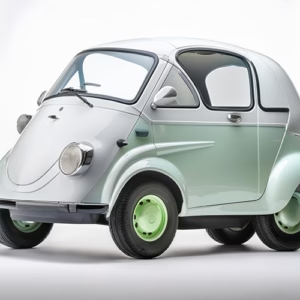
The original Isetta was an Italian-designed “bubble car” dating from the early 1950s.
A true icon of unusual automotive design, the BMW Isetta was originally an Italian-designed bubble car from the early 1950s.
The Isetta came with:
-
A tiny 9.5-horsepower engine
-
A single rear wheel (later upgraded to two to prevent tipping)
-
No side doors
Its most unique feature was the front-opening mechanism. The entire front end—dashboard included—swung open to let the driver in. Practical? Not exactly. Memorable? Absolutely.
GM Sunraycer 1987
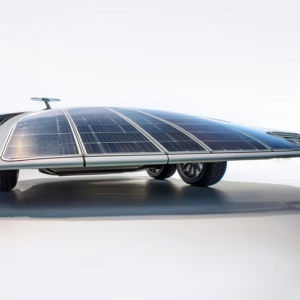
GM’s 1987 Sunraycer was built to race in the middle of Australia using only the power of the sun.
Built for innovation rather than comfort, the GM Sunraycer was created to race across the Australian desert using only solar power.
Key highlights:
-
Powered by 7,200 solar cells
-
Reached speeds of up to 60 mph
-
Designed exclusively for the World Solar Challenge
This futuristic vehicle now rests at the Smithsonian American History Museum in Washington, D.C., as a testament to early solar-powered mobility.
Peel P50 (1962–1965)
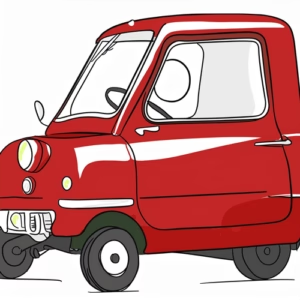
Officially the smallest production car in the world, the Peel P50 measures only 54 inches long and 41 inches wide.
Notable quirks:
-
Designed for “one person and a grocery bag”
-
Only 50 units were produced
-
A single door, one headlight, and one windshield wiper
In 2016, one of these tiny cars sold at auction for an astonishing $176,000, proving that weird can also be valuable.
F 015 Luxury in Motion 2015 by Mercedes-Benz.
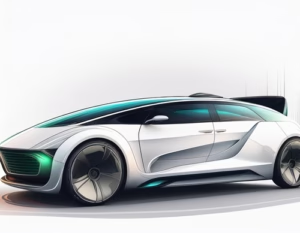
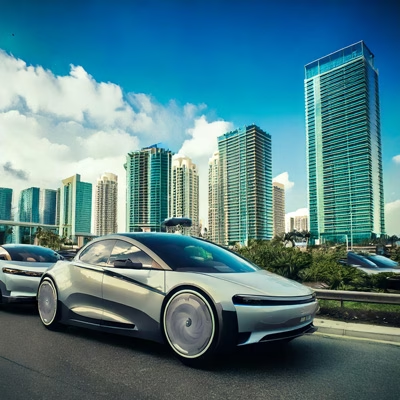
When it comes to futuristic prototypes, the F 015 Luxury in Motion is in a league of its own. This autonomous concept imagines a world where the car is a moving private lounge.
Highlights include:
-
Four swivel armchairs in luxurious white Nappa leather
-
A minimalistic interior designed for relaxation
-
A steering wheel that only emerges when needed
-
A vision of transportation where the driver becomes optional
Mercedes describes it as a “private retreat”—a radical rethinking of luxury mobility.
Fiat Multipla 1999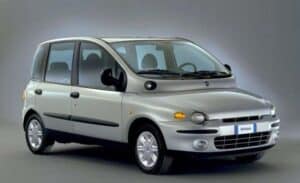
Often labeled as one of the ugliest cars ever made, the Fiat Multipla sparked strong reactions from the automotive community.
Its unusual design elements included:
-
A cab-like body
-
High, aquarium-style upper glass area
-
Round headlights placed in unexpected locations
-
A unique interior with six seats arranged in two rows of three
While its practicality was undeniable, its looks were not everyone’s favorite. A redesign in 2004 greatly improved its aesthetic appeal.
Why Weird Car Designs Matter
Strange, experimental cars—whether iconic or awkward—push the boundaries of automotive innovation. They challenge designers to think differently and help shape trends that later become mainstream.
These rare creations remind us that creativity often starts with bold, unconventional ideas.
FAQs About Weird Car Designs
✅ Why do some car manufacturers create such strange or unusual designs?
➡️ Manufacturers experiment with odd designs to test new concepts, explore aerodynamics, reduce production costs, or generate media attention.
✅ What makes a car design “weird”?
➡️ A design is considered weird when it breaks traditional visual proportions, uses unconventional shapes, or prioritizes unusual functions over aesthetics.
✅ Are weird-looking cars usually prototypes or production vehicles?
➡️ Most extremely unusual designs start as prototypes, but several—like the Peel P50 or Fiat Multipla—make it into mass production.
✅ Do weird car designs ever become valuable?
➡️ Yes. Rare vehicles with unique designs often become collectible over time. The Peel P50 is a great example, selling for six figures at auction.
✅ Were weird car designs more common in certain eras?
➡️ The 1950s–1970s saw many experimental designs due to rapid technological changes and cultural shifts. Modern concept cars continue the trend.
✅ Why do some “ugly” cars gain cult followings?
➡️ Because their uniqueness makes them stand out. Enthusiasts appreciate their character, rarity, and the bold design choices behind them.